








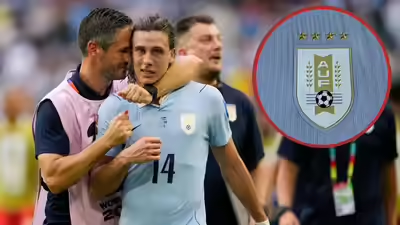
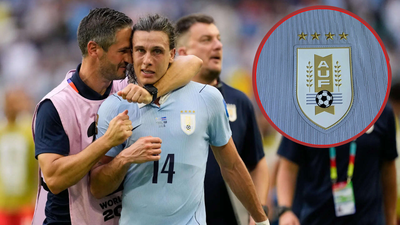
Uruguay expected to arrive in 2026 fifa world cup Carrying one of the most unique badges in international football. While most supporters know that the star above the national team’s crest usually represents World Cup victory, Uruguay’s crest seems to tell a different story. La Celeste officially won the FIFA World Cup twice, lifting the trophy in 1930 and 1950. However, the four stars sit proudly above the federation crest on their jerseys, leaving many supporters to wonder if the South Americans are claiming glory that is not theirs.The answer lies in a unique chapter in football history that predates the creation of the World Cup itself.Marcelo Bielsa’s side continued their 2026 campaign with a 1-1 draw with Saudi Arabia before being held to a 2-2 draw by Cape Verde, who were participating in their first World Cup appearance, and the four stars remain one of the most prominent features on Uruguay’s jersey. They are also officially recognized by FIFA, reflecting a period when the Olympic Games represented the highest level of international football competition in the world.
Why Uruguay has four world championships
The explanation is simple once you understand the historical background.Uruguay’s four stars represent the four world champions recognized by FIFA:
- 1924 Paris Olympics
- 1928 Amsterdam Olympics
- 1930 World Cup in Uruguay
- 1950 World Cup in Brazil
The Uruguayan Football Federation explained this significance in a statement in 2021.“The four stars symbolize the gold medals from the 1924 and 1928 Olympic Games and the 1930 and 1950 World Cup.”
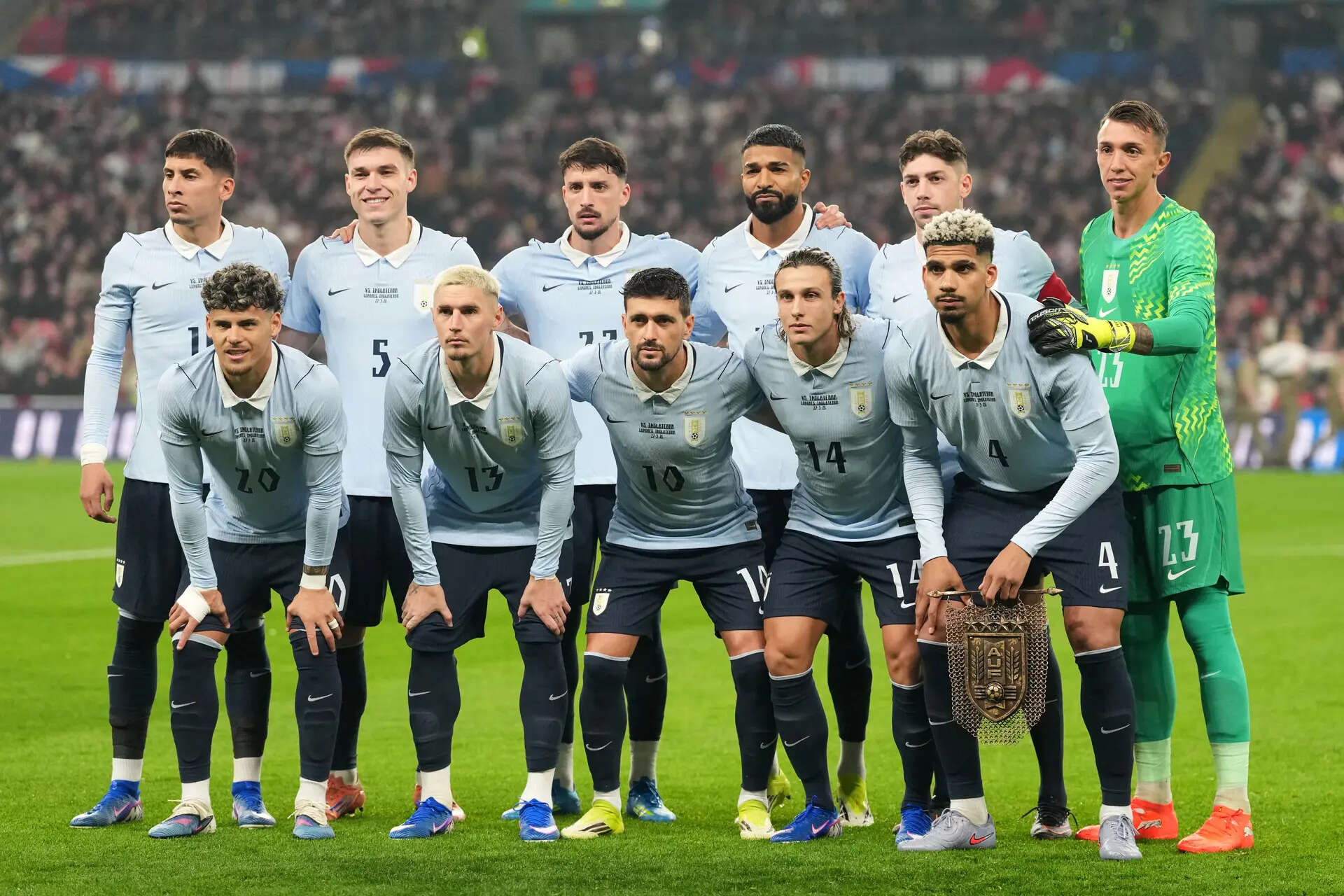
FILE – Uruguay players pose for a team photo before the international friendly match between England and Uruguay in London, Friday, March 27, 2026. (AP Photo/Alastair Grant, File)
The key detail is that the 1924 and 1928 Olympic football tournaments were organized under the authority of FIFA before the creation of the World Cup. As such, these championships are considered equivalent to the Senior World Championships of that era.Although many modern supporters associate Olympic football with age limits and youth teams, the face of the sport was very different in the 1920s. At the time, the Olympic Games represented the highest level of international football competition.
How Uruguay earned its first two stars
The story begins a few years before the World Cup.The 1920 Olympic Football Championship in Antwerp had already demonstrated the sport’s growing international appeal, while the 1924 Paris Olympics marked a major step forward in terms of scale and global participation.Uruguay arrives in Europe with a growing reputation after impressing in South America against visiting European opposition. Their performance earned them an invitation to tour the continent, a trip that eventually evolved into competing in the Olympics.The tournament features 22 teams and is often considered the first truly international football competition.Speaking on an episode of the Olympics.com documentary series Vault: the treasure of the Olympic GamesJocelyn, director of the Olympic Museum, explained the significance of the event.“With 22 teams competing in Paris in 1924, it was the first truly international tournament as we know it today.”Uruguay justified the journey in spectacular fashion. They reached the final and defeated Switzerland 3-0 to win the Olympic gold medal and receive what would become the first star above their crest.This achievement is still of great significance in the history of South American football, so CONMEBOL designated June 9 as South American Football Day.Four years later, Uruguay defended the title in 1928 in Amsterdam.This time, they emerged from a tournament involving 17 countries and beat neighbors Argentina 2-1 in the final. A second consecutive Olympic gold medal established Uruguay as undoubtedly the strongest football nation in the world and added a second star to its growing legacy.
Events that inspired the World Cup
Uruguay’s Olympic success comes at a time of rapid growth for international football.The growing popularity of the sport, coupled with the emergence of professional players, convinced FIFA that football needed its own global competition.In 1928, FIFA officially decided to establish the World Cup.Several countries, including Hungary, Italy, the Netherlands, Spain and Sweden, submitted bids for the right to host the first World Cup. That honor eventually fell to Uruguay, partly because of the country’s achievements in football and partly because 1930 was the centenary of Uruguay’s independence.The organizers have spared no effort in preparing for this event. Uruguay was willing to cover travel costs for participating teams and built what would become one of the most iconic venues in football, Montevideo’s Estadio Centenario.There are 13 teams participating in this competition, 9 from the Americas and 4 from Europe.At the end of the tournament on July 30, 1930, Uruguay faced Argentina in the final.The rivalry between the neighboring countries is so intense that they cannot even agree on the use of the match ball. A compromise was eventually reached, with the Argentinian ball used in the first half and the Uruguayan ball used in the second half.At halftime, Argentina led 2-1.Uruguay fought back strongly after the halftime break, scoring three goals in a row to win 4-2 and become the first World Cup champion.The victory added a third star to the crest and cemented Uruguay’s place in football history.
fourth star and maracanazzo
If the victory in 1930 made Uruguay a footballing power, the events of 1950 turned Uruguay into sporting folklore.Only 13 teams participated in the 1950 World Cup in Brazil, with Uruguay advancing easily in the early stages, including an 8-0 sweep of Bolivia.They then drew 2-2 with Spain and then reversed course to beat Sweden 3-2 to set up a decisive match with host Brazil.The game was held at the newly built Maracanã Stadium, with approximately 200,000 spectators. Brazil needed just a draw to clinch the title and entered the match with a commanding lead after beating Sweden and Spain.The atmosphere inside the stadium was unlike anything the football world had ever seen before.Brazil took the lead and looked destined for glory.Uruguay refused to accept the script.The visiting team scored twice in the second half to complete a stunning comeback and win 2-1, which remains one of the biggest upsets in football history.The result was immortalized as “Maracanazzo”. Translated as “Maracana Crush,” Uruguay won its second World Cup and fourth crudely recognized world title.Years later, Alcides Ghiggia, who scored the winning goal, uttered one of the most famous quotes in football.“Only three people in history have been able to silence the Maracana with just one act: the Pope, Frank Sinatra and myself.”In 2015, Gigia died at the age of 88 on July 16, the anniversary of the 1950 “Maracanazo”. The defeat affected Brazil so much that the Brazilians retired the white jersey from their jerseys.
Why keep four stars?
The controversy surrounding Uruguay’s stars occasionally resurfaces whenever major international tournaments take place, but FIFA has always acknowledged the country’s right to showcase all four.The reasons are rooted in football’s historical timeline, rather than any modern reinterpretation of success.Before the World Cup, the 1924 and 1928 Olympic Football Championships represented the pinnacle of international competition and were organized under the authority of FIFA. Uruguay won the first World Cup in 1930 and achieved one of the sport’s most famous victories 20 years later in Brazil.Therefore, the four stars above Uruguay’s crest do not represent a misunderstanding or vulnerability. They represent four world titles won in two different eras of international football, from the Olympics in Paris and Amsterdam to the World Cup finals in Montevideo and Rio de Janeiro.