








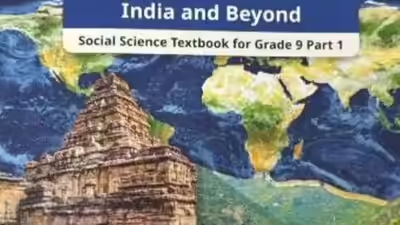
The National Council of Educational Research and Training (NCERT) has included a verse from the Manu-smriti in its newly introduced Class 9 Social Science book to explain that women were respected during the Vedic period. The Manusmriti has been controversial for years. Many critics say that it justifies social inequality, while others defend it as part of India’s civilizational heritage and say that its teachings are often misinterpreted.In the NCERT book, in the chapter State and Society up to 1000 CE, the textbook says that the Vedic period is “often described as a period during which women enjoyed a high and respectful position in society.”The textbook adds that the tradition of respecting women continued in texts written after the Vedic period. He then quotes Manu-smriti 3.56, which says: “Where women, indeed, are honored, there the gods rejoice; where, however, they are not honored, there all sacred rites prove fruitless.”Shortly after quoting the verse, the textbook says that the status of women has changed over time. He says: “Over time, the position and roles of women fluctuated, even decreased, as social and political conditions changed. However, there are many examples of women who continue to contribute to family management, agriculture, crafts and religious practices.”The chapter also gives examples from later periods. He says that the literary works of the Gupta-Vakataka period describe educated women skilled in the arts and mentions queens who played an important role in government and religious patronage. It also highlights women mentioned in Sangam literature as active participants in society and economy.The textbook also revisits the concepts of varna and jati. He says that the early Vedic society did not assign social status on the basis of birth alone. According to the book, social identity was formed by many factors, including ethnicity, region, language, occupation and cultural relations.He also explains that the four varnas are gradually linked to specific roles, but were originally conceived as functional categories rather than rigid divisions. According to the textbook, the jati system later developed through intermarriage between communities, endogamy and territorial differences. He adds that while the number of varnas remained fixed at four, there was no limit to the number of jatis, which continued to increase as new occupations and social groups emerged.