







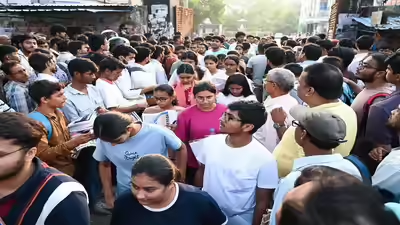
As more than 22 lakh candidates appeared for the NEET-UG 2026 re-examination on Sunday, Prime Minister Narendra Modi delayed his departure from the Delhi airport to avoid traffic congestion that could have affected students traveling to their exam centres.According to reports, the Prime Minister arrived at the airport around 1:15 pm but chose to wait until the examination began at 2 pm. The decision was taken to ensure that students heading to centers across the National Capital Region did not face additional traffic disruptions caused by the movement of a high-security convoy.The gesture came on a day when lakhs of aspiring medical students were attempting one of the most consequential exams of their lives. The NEET-UG 2026 re-examination was held after the National Testing Agency (NTA) canceled the original test on May 3 following allegations of a question paper leak.
Students at the center of attention
The retest drew nationwide attention after weeks of controversy over the integrity of the exam process. For the candidates, Sunday represented a second opportunity after months of preparation were put into uncertainty by the cancellation of the first exam.Against this backdrop, ensuring that students reach their centers without delay has become a top priority. The Prime Minister’s decision to postpone his departure was seen as an effort to prevent any disruption during the critical reporting period.Union Minister Sukanta Majumdar lauded the move, describing it as an example of responsibility and concern towards citizens, especially students appearing for a high-stakes national exam.
Massive security operation for review
The NTA has developed one of the largest security arrangements ever seen for a national entrance exam to ensure that the retest is conducted without irregularities.Applicants are allowed entry only after undergoing strict search procedures, including metal detector checks. Examination halls are under CCTV surveillance, while electronic signal jammers provided by government agencies have been installed to prevent digital malpractice.Each exam room was monitored by two invigilators, and more than ten officers were deployed in each center to supervise the performance of the test.
Thousands deployed across the country
To enhance security, the NTA has deployed 38,795 research personnel and 48,448 biometric staff members for authentication and face verification. About 6,700 observers and more than 100 virtual observers also monitor the examination process.On average, each examination center was provided with 40 to 50 security personnel.Authorities have also involved police forces, paramilitary units, the Indian Air Force and the Department of Posts in the transport and protection of confidential examination materials, underlining the scale of the operation.
Welfare measures for candidates
In addition to the security arrangements, special arrangements have been made for the welfare of the candidates. The centers have been equipped with drinking water facilities, ORS, ambulances, shaded waiting areas and seating arrangements for parents accompanying the students.Additional sheets and wall clocks were also provided, while extra time was built into the entry process to account for the enhanced security checks.With more than 22 lakh candidates taking the exam, authorities hope the extensive agreements will help restore confidence in a test that has faced unprecedented scrutiny this year. In a day dominated by concerns about fairness and smooth conduct, the Prime Minister’s decision to delay his departure added a symbolic message: ensuring that students reach their exam centers on time was a priority.