








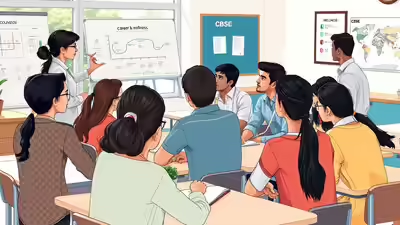

In January 2026, the Central Board of Secondary Education (CBSE) took an important step by making school counseling compulsory in all affiliated schools. Under its revised affiliation statutes, each CBSE school must designate a dedicated counseling and welfare teacher for socio-emotional support and a separate career counselor for academic and vocational guidance, maintaining a ratio of one counselor for every 500 students in Classes 9 to 12.With schools given two years to implement the mandate, the focus must now shift from simply complying with regulations to building robust and sustainable support systems that truly meet the needs of students.The timing could not be more significant. A 2025 study of 30 universities found that nearly 70 percent of Indian students — from school to university — reported moderate to high levels of anxiety. Student suicides have also been on the rise steadily for more than a decade. According to the IC3 Institute’s University Report 2025, India recorded 13,044 student suicides in 2022 alone – a 64 percent increase over the previous decade. Surveying more than 8,500 students in grades 8 through 12, the report also found that one in five students rarely feel motivated, peaceful or excited to be alive.Alongside these emotional challenges, today’s teenagers are navigating stream choices, college admissions and career decisions in an increasingly complex world. Against this backdrop, the CBSE mandate represents much more than a political intervention – it recognizes an urgent and evolving reality.“For the first time, we have a policy that unequivocally positions counseling as an integral part of school education, not an add-on,” says Ganesh Kohli, founder of the IC3 Movement, which has spent a decade building a global platform for school counseling professionals. “This is a real opportunity to change the way students experience the transition from school to the next, replacing uncertainty with clarity and pressure with support, and helping young people make important decisions with more confidence and agency.“
Why career separation and wellness counseling matter
One of the most consequential aspects of the CBSE notification is its decision to distinguish between two specialized counseling functions that schools had traditionally expected a single professional to perform.Welfare counseling and career counseling require different skills, different training paths and different relationships with students. Combining the two responsibilities often meant that neither received the attention they deserved.Debika Chatterji, Principal of JBCN International School, Mumbai, believes this distinction is fundamental.“Having professionals who are trained specifically for each dimension means that students get the depth of support they really need, at the right time.”The scale of implementation is considerable. With nearly 24,000 CBSE-affiliated schools across India, the policy has effectively created demand for tens of thousands of trained counseling professionals, putting new focus on the country’s ability to prepare them.
Build a profession, not just fill vacancies
India’s counseling ecosystem has evolved quietly in recent years, driven largely by institutions and organizations that see counseling as a profession long before politics formally recognizes it.Since 2018, the IC3 Institute has developed the capacity of schools to provide high-quality careers and university advice through its flagship Empower programme. Offered at no cost, the annual certification has ensured that access to professional development is not limited by financial resources, enabling thousands of school counselors and educators in India and around the world to establish and strengthen counseling practices in their schools.In addition to this, the Career Development Association India offers internationally approved certifications, including post-graduate credentials recognized by NCDA USA, widely regarded as the global standard in career counseling.IGNOU’s Certificate in Guidance and Counseling provides an accessible distance learning pathway for B.Ed. and M.Ed. graduates entering the profession. On the welfare side, TISS Mumbai’s Postgraduate Diploma in Counseling continues to be one of the country’s most respected programs for school-based mental health professionals, while NCERT’s Diploma in Guidance and Counseling supports a teacher-counselor model that allows educators to integrate guidance into their existing responsibilities.Students pursuing the academic path can also meet the CBSE eligibility criteria through an MA in Psychology, with well-established programs offered by institutions such as Delhi University, Christ University Bengaluru, Fergusson College Pune and SNDT Women’s University Mumbai.Kohli believes that continuous professional development will be central to the growth of the profession.“Preparing young people for an ever-changing world requires counselors who are continually learning themselves. As careers evolve, higher education pathways diversify, and student needs continue to change, professional development cannot be a one-time exercise. It must be continuous, reflective and practice-based.”The IC3 Institute’s research reinforces this need. Its Student Quest Report 2025, based on five years of longitudinal data alongside a new global survey of the graduating classes of 2026 and 2027, found that 80 percent of students believed that counseling allowed them to make better-informed career and college decisions, while 61 percent said that career counseling improved their overall well-being.The report also highlights a wider shift among students – from prestige-driven aspirations towards alignment of values, mental health and long-term purpose. Nearly half of all students begin thinking seriously about careers between the ages of 12 and 14, making these middle school years a critical window for structured guidance.
What schools are experiencing on the ground
For schools that invested in the board long before the CBSE mandate, the notification validates an approach they had already embraced.At KR Mangalam World School, Delhi, Principal Jyoti Gupta points out the importance of timely career guidance during crucial academic transitions.“When students have access to trained guidance at the right time, they make more informed choices, and that confidence carries forward into everything that follows.”The separation of career and wellness roles also resonates with school leaders who regularly witness students seeking support for intertwined emotional and academic concerns.At RP Goenka International School, Kolkata, International School Principal Daisy Rana says career counseling today requires experience that extends far beyond admissions guidance.“Treating it as a specialist role is the right approach. Students today consider paths that did not exist ten years ago.”The need becomes even more pronounced in schools that serve students from diverse socioeconomic backgrounds, where emotional well-being and career uncertainty often intersect.Pooja Rao, School Psychologist and Head of Impact at Avasara Academy, Pune, sees these areas as inseparable.“Student well-being and achievement are not separate conversations. Schools that have found ways to support both have seen the difference it makes in engagement, in resilience and in the choices that students have to make.”For Sonali Gandhi, Principal of Jamnabai Narsee School, Mumbai, the mandate institutionalizes what progressive schools have long believed.“The CBSE mandate gives schools the framework to invest in counseling more deliberately. It moves the conversation from whether schools need counselors to how well those counselors are supported.”
Making implementation practical
Recognizing that schools differ significantly in their resources and preparation, the CBSE notification also introduces a hub-and-spoke model. Smaller schools will be able to access counseling support through designated hub schools, making implementation more feasible during the transition period.Schools that already have counseling infrastructure are naturally better positioned to comply quickly, while others need to build systems from the ground up. The two-year implementation window is intended to bridge this gap while allowing institutions to recruit qualified professionals and establish effective support mechanisms.Education leaders widely agree that the mandate establishes a strong foundation by clearly defining counselor roles, eligibility criteria, and institutional responsibilities. However, translating the policy into meaningful impact will require sustained investment in training, institutional commitment and collaboration across the education ecosystem.
Beyond compliance: A new vision for education
For Kohli, the larger meaning of politics extends beyond regulatory compliance.“India has the largest school population in the world. Every step to ensure that every student has access to a qualified counselor is a step towards a more supportive and equitable education system. The vision has always been advice and well-being in every school, and today, that vision feels more achievable than ever.”For decades, schools have mainly prepared students for exams. Moreover, they are also expected to prepare for the decisions that will shape their future.CBSE’s revised statutes signal a broader transformation in the school’s purpose—one that recognizes that students need support not just academically, but also emotionally and developmentally. In recognizing that helping young people navigate uncertainty, discover purpose and make thoughtful choices is an essential part of education, the policy marks an important step towards building schools that prepare students not just for exams, but for life.